Is Trump Going to Start a World War? Or, the Price Americans Will Pay For One
Today we’re going to cut to the chase. And discuss the question that’s on a lot of minds. Or maybe shaking at the tips of many nervous fingernails.
Is Trump going to start another World War?
Venezuela. Cuba. Colombia. Canada. The Americas. Greenland. Europe. That’s just a partial list. These are just some of the places Trump has already threatened or, of course, already begun to attack. And that’s already quite a bit of the world.
If you wanted to start a world war, this would—go ahead and chuckle—be a pretty good way to do it. Create flashpoint after flashpoint. Already straddling perhaps half the globe.
I don’t know if Americans fully see or grasp the enormity of what their country is now beginning to do to the world. Recently, we discussed how America’s now entering the expansionist phase of fascist collapse. But of course it is precisely that phase which ignites large-scale conflicts—and usually leaves those who spark them in ruins.
But what do large-scale conflicts mean in this day and age? We are going to talk about finance and economics, prosperity and ruin, despair and self-destruction. Because in the end, all this only finishes one way: it is Americans who will pay a severe, steep price, in real, hard terms. America will be left out in the cold, quarantined, and Americans will be left much poorer as a result.
Flashpoints. We can only say when world wars start in retrospect. The assassination of an archduke. The invasion of a neighboring country. And here, what Trump is creating is a world full of flashpoints.
Flashpoints lead to chain reactions. And here there are a multiplicity of chain reactions that are just waiting to explode. The obvious ones: China takes Taiwan and then more of Asia, and Russia pushes its way bloodily into Europe. But there are less obvious ones, too. Territorial conflicts erupt as powers defend the resources they’ve acquired in smaller, less powerful nations, whether Latin America or Asia.
But I don’t want you to think just at the micro level—trying to trace through the webs of conflicts to come. The clearer way to understand the place we are at now as a civilization is at the macro scale.
Trump may not have declared a World War just yet, as if threatening open hostility on half the world is some kind of saving grace—but that misses the point entirely. Trump has declared war on the idea of global peace, freedom, and consent.
And so has America.
He is trying to, as we’ve discussed, annihilate the idea of sovereignty itself.
And so is America.
(No, maybe not you, personally, but let me assure you: the world doesn’t care much about that part. Just ask a Canadian or European, go ahead and chuckle if you are one.)
Let me make that a little visceral for you. Venezuela just “agreed,” LOL, to give the US $2 billion worth of oil. And Trump said:
“This Oil will be sold at its Market Price, and that money will be controlled by me, as President of the United States of America, to ensure it is used to benefit the people of Venezuela and the United States!” Trump said in a post online.
$2 billion dollars. Sound like a lot? That’s 0.005% percent of America’s GDP. Was it worth trashing America’s reputation, credibility, and place in the world…for this? The price will be far, far higher than this infinitesimal sum, the everyday American will pay it, and it will scar America for decades.
These ideas, peace, democracy, and consent, are expressions of the Mother Right of sovereignty. And all this ranks amongst the greatest human accomplishments of them all. Not just at the level of a nation-state, but among nation-states. When we speak of “a global order,” that almost hides the true meaning and import of the deeper idea that we can have a self-determined, self-chosen order, not just the strong preying on the weak. That we can have to a world founded on sovereignty, which means freedom, which in turn means ideals of nonviolence, dignity, and cooperation—or at least aspires to them.
(No world is perfect, of course, so let’s save the leftist grad school objections for another day, please.)
It’s trivial to say that Trump wants a different global order. But understand what has really happened here. Having declared war on the idea of sovereignty means America has declared war already now on democracy, peace, and consent, as founding ideals of a world-system. And so now the seeds have been sown.
What does a world without sovereignty really look like? For nations. For people. For worlds. The 1930s teach us a grim lesson.
This is how to think about the grim possibility of another world war. When our macro-scale institutions are left in tatters, the ones which underpin and undergird the idea of a civilized globe, then the risks of world war rise that much more dramatically. Because of course now anything goes, in any way. Risk cascades through such failing systems.
And in this way, we’re at a civilizational turning point. We now face a level of macro risk that we didn’t before, which is that any moment, these flashpoints could very well lead to the kind of chain reaction which ignites beyond anyone’s control.
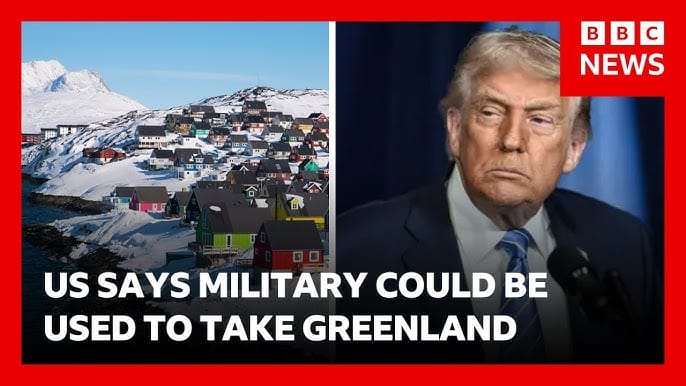
Let us imagine that next week, Trump decides to try and annex Greenland. Already, America’s massing its military in Britain. What happens next? Does China, the very next day, seize Taiwan? Does Russia invade Poland, in an eerie parallel of the last world war? Again, those are obvious examples.
Here are less obvious ones. The EU retaliates not militarily, but financially. It goes nuclear, and dumps its US assets, from stocks to bonds. Bang. There go America’s 401Ks. China joins it, and things go from bad to worse. And of course, because they don’t want to be left holding assets worth pennies on the dollar, Japan and the Arab states race in, too.
The stakes now are stark and severe. I don’t think that Americans, at least many of them, fully grasp where they are.
America is now the country that is sparking the embers of instability everywhere. It is now something we have few words for. “Rogue superpower” and so on don’t really come close anymore. Abducting a head of state isn’t like the foolish misadventures before, because then, America was hardly threatening to invade Europe and Canada, too. Not since the 1930s have we seen a nation of any stature declaring war on civilization itself.
The world will now be forced into a choice it is reluctant to make. It will have to “decouple” from America. That phrase means that it will have to end its interlinkages and relationships with a nation that is overtly violent, hostile, and aggressive towards it. Those include all kinds. Not just alliances and treaties. But more crucially, financial, economic, and strategic ones.
It’s one thing to say: America can’t be depended on anymore to be a friend and ally. It’s another to say: America can’t be trusted not to invade, conquer, or control you. These are different levels of breakdown in relationships. The first is a lack of trust. But the second is a breach and betrayal.
The world doesn’t want to decouple from America. That is why the process has been relatively quiescent. But now it must accelerate. It’s a fantasy to imagine that a world which is now kept awake at night by the specter of a world war started by America will want to continue to be invested in it, diplomatically, financially, economically.
And it’s folly to imagine that the world doesn’t understand that Trump has declared war on the idea of a peaceful, stable, and civilized one. Americans will pay a severe and steep price for this. America’s reputation, already in tatters, will never be the same. Now America will be something to be kept at bay, to keep locked away, like other dangerous, unstable nations.
And as the world runs away from an America that’s now destabilizing it, often violently, it’s Americans who will grow impoverished, in the end, because the sources of growth for an economy remain trade, investment, relationships, and trust. But all those depend critically on peace, democracy, and consent.
How many authoritarian, fascist nations have roaring economies? None do. The single greatest breakthrough in human prosperity wasn’t the microchip or the engine. It was democracy itself. We know this to be true, because it was only after the Age of Revolutions that prosperity made its sudden, explosive gains.
Think of how America sanctions nations. Now imagine a world which treats America that way. Do the nations America sanctions prosper? They’re in tatters. Now understand what an America being sanctioned by the world, effectively, would look like. Even with all its guns and bombs, can America conquer the entire world? Of course not. In the end, the world will win this foolish game, and America must lose.
That is where this road begins.
Where it ends is with the world demanding that America, in the end, make good for the harm it is doing now, and will continue to do. And the world has the power to enforce that, too, because of course, it owns America’s debt. In this way, too, impoverishment beckons for Americans. What will the world demand to accept America as a member of civilization, not something closer to Russia, Iran, or North Korea, now? What price will it ask? And how will Americans pay it, because certainly, Trump won’t?
We’ll discuss all this more in the coming days. War is not just about violence, my friends. It is about even more than that. It is about how nations rise and fall, prosper and grow impoverished, and in what stead the world regards them in. Do Americans understand that they are becoming something that the world must now abjure and reject, for the sake of civilization itself?
I wonder.
Lots of love,
Umair (and Snowy!!)
❤️ Don't forget...
📣 Share The Issue on your Twitter, Facebook, or LinkedIn.
💵 If you like our newsletter, drop some love in our tip jar.
📫 Forward this to a friend and tell them all all about it.
👂 Anything else? Send us feedback or say hello!
Member discussion