THE TRICKLE UP ECONOMY AND THE NEXT 1929
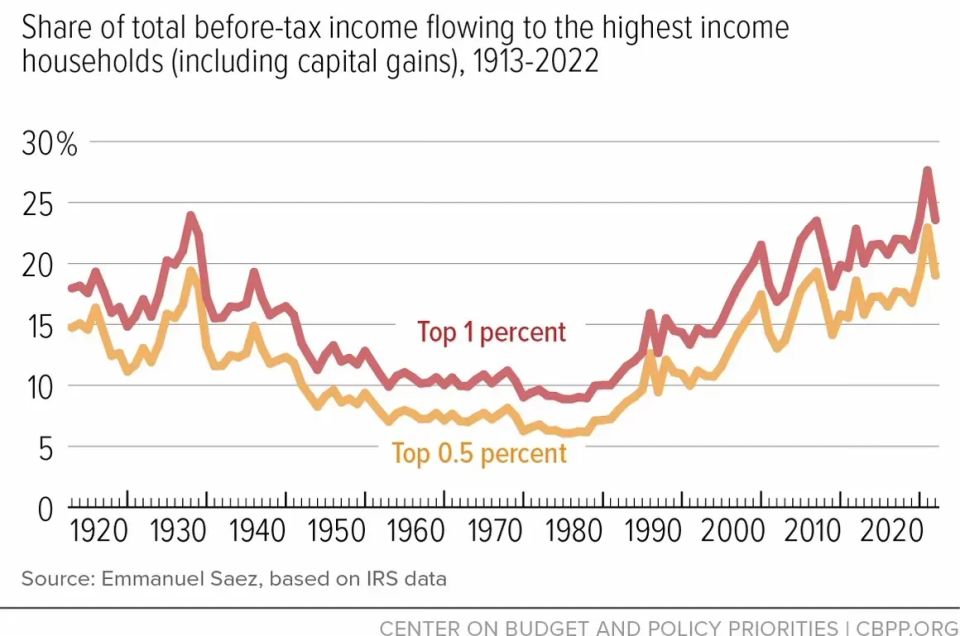
See the chart above? Look carefully. Here’s what it says. We’re now in a more lopsided economy than 1929. Rarely have I seen a divergence so stark, so severe—and so calamitous. Between Main Street and Wall Street, or between finance and the real economy. It’s a tale of two parallel universes. And tales like this inevitably end in catastrophe.
If you look at America’s financial markets, aka stock markets, you’d never know anything was wrong. How dismal a shape the real economy’s in. Record highs, day after day—you should take that with a grain of salt, because they’re always record highs. What you should note, and maybe already have is: while the world is unravelling?
Stock markets are blissfully tuning out every form of risk now sweeping across the globe, from macroeconomic disintegration to geopolitical chaos to America’s real economy entering stagflation and worse (and we’ll come to that in a moment.) They’re high on a drug called greed, and like a drug, they’re too hammered by the dopamine rush to notice the parlous state everything is now in. How long can it last?
The real economy, meanwhile, is going from bad to worse. America’s real economy has been doing very, very badly for decades now, hence, the siren song of Trumpism. But now things appear to be entering a grim new phase.
Half of young people are unemployed or underemployed. Entry level jobs have all but vanished. The labor market for everyone else is frozen. If you’re over 50, good luck having a professional career ever again. What jobs have been created have all been in healthcare—every other industry has lost jobs. (Those stats and more are here.)
And the further down the socioeconomic ladder you look, the more people are struggling. The use of debt to pay for basic bills is mounting, as are delinquencies. The bottom half of Americans have nothing to save, and about half of Americans have little to nothing saved for retirement. That’s true down the generations, too—this is a portrait of declining living standards intergenerationally and socioeconomically.
I could go on with statistics, but I think we all know enough of them. Let me connect the dots for a moment.
Welcome to the Trickle Up Economy. What’s happened to America over the last few decades is that wealth, far from “trickling down,” has trickled up. From the very bottom, to the top. And trickle is an understatement. It began as a trickle, but now it’s something more like a gusher.
I think that we all sense this. And I’ve used different names for it myself, extractive economics, predatory capitalism, and so on. The labels aren’t the point—the dynamics are.
The only way that there is a disjuncture this severe, stark, and jarring between finance and the real economy is when wealth trickles up. Is extracted and siphoned upwards. Some time ago, it was estimated that had incomes kept up with productivity gains, Americans would be much, much wealthier. That never happened, precisely because wealth trickled up. And of course that way, the once merely rich became mega rich, super rich, and now imperially rich.
The problem with a trickle up economy isn’t just a moral one, though we should all ask ourselves if such an economy is a good thing.
The problem is this. At some point, there’s nothing left to trickle up. And at that point, the game of musical chairs stops. The house of cards comes crashing down. And at that—bang. Implosion.
in other words, the divergence between finance and the real economy can’t last forever, and it always suddenly correctsitself. The more severe the divergence, the more harsh and brutal the correction, the coming back to reality. Right now? The divergence is as extreme as it’s been in modern history, maybe the most, period.
We call moments like those crashes. They presage depressions. This is what happened in 1929.
Where’s the breaking point? Understand what’s happened in the American economy over the last several decades. Wealth trickled up from the working class to the elite, through mechanisms like offshoring. Then from the lower middle class and middle class, through surreal financial games, like “raiding” pensions.
And now what's left? This machine appears to be coming for what wealth is left for it to extract. Even the recently affluent tech class is about to be consigned to the very same precarity and poverty of the working class. Young people appear to have little chance of a stable or prosperous life at all, precisely because their future wealth has already been siphoned away, through things like “student debt.” The elderly are asked to choose between their homes and their lives. So the few pools of wealth left—the relatively small upper middle class, the young, the elderly—are now being siphoned off, too.
Bang.
Breaking point is hit this way. Somewhere along this road, the system crashes and burns. It’s eaten itself alive. Cannibalized its own limbs and then organs until nothing was left.
This is the problem with Trickle Up Economics. I think most of us who are thoughtful people have long known it, and warned of it, precisely because we didn’t want to see any of this happen.
All this has a meaning. Implications. Any good investment strategy had better be thinking very, very carefully about all the above. Dysfunctional and malfuction. The dangerously delusional divergence between finance and the real economy. Breaking point. The harder and more brutal the greater the divergence. 1929. Implosion. There are always intelligent ways to make money—and foolish ways to lose it. Be careful.
Love,
Umair (and Snowy!)
❤️ Don't forget...
📣 Share The Issue on your Twitter, Facebook, or LinkedIn.
💵 If you like our newsletter, drop some love in our tip jar.
📫 Forward this to a friend and tell them all all about it.
👂 Anything else? Send us feedback or say hello!
Member discussion