Trump Always Chickens Out—But the Damage is Already Done (Or, Risk, Catastrophe, and Finance)
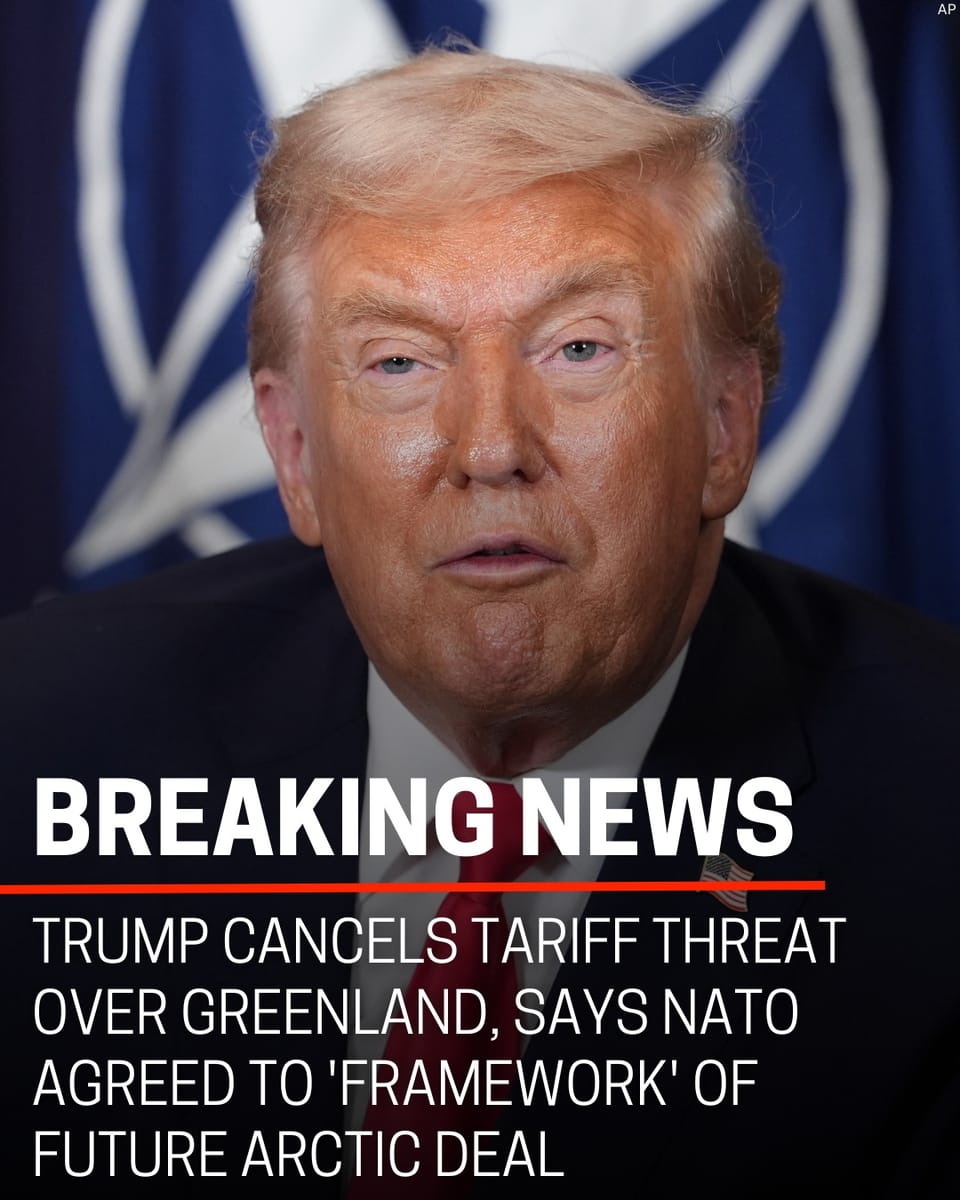
He did it again. Trump “cancelled” his tariffs over Greenland. He always chickens out. So no big deal, right? Wrong.
Today we’re going to talk about risk. And how it matters to the world, economics, finance, and geopolitics.
Here’s why Trump backed down, by the way. In the last post, I taught you how trade wars escalate to capital wars, which is a sentiment, interestingly, that Ray Dalio echoed (he runs a hedge fund.) Trump backed down precisely because Europe taught him that this was a capital war he couldn’t win, that it holds the cards in terms of investment by its large funds and so forth.
What does all that mean? It’s a good thing that, LOL, Trump isn’t going to invade Europe tomorrow. But the question before us isn’t that, in the same way that saying, whew, I guess a planet-killer of a meteor not hitting is a good thing. The question is: how much damage has already been done?
It would be pretty naive to say: everything’s fine now!, wouldn’t it? No biggie guys, let’s be friends again! Go ahead and chuckle, especially if you’re European.
Here’s what I’m not telling you, and never have been. It’s going to be the Purge by way of Max Max tomorrow. Run for the hills everyone! That’s a caricature. We’re talking about risk. And if we’re going to take it seriously, then we are in a new world of it, and we need to manage it well. Havens is doing very well in terms of hard performance for precisely that reason, as those of you who’ve done sessions with me know, and I’ll talk more about that tomorrow.
Imagine that there was a business which used to be a titan. Well-managed, reliable, trustworthy. A safe investment. Only now…things have changed. The board is out to lunch, or playing golf. The CEO’s more interested in intimidation, coercion, and bullying than actually growing the business, or even really doing much business. There he is, sparking a trade war. There he is, blowing out its debt to infinity. Meanwhile, the shareholders, many of them, back all this, or at least turn a blind eye to it.
Would that be a good investment?
No! That’s what we’re talking about. It would be a bad investment, and you sense this intuitively, because it would place your capital at risk. Because this company was no longer well-managed. Now it’s very badly managed.
Countries aren’t companies. I’ll be the first to warn of that. But the principles of risk and management still very much apply.
Now. Let’s talk about Trump, intimidation, coercion, and “chickening out.” It’s true that he chickens out, but it’s truer that the damage is still done. Making good on the threat may be cataclysmic, but just issuing it is catastrophic.
It isn’t just that it corrodes trust and confidence, which it certainly does, but the invisible flipside, or what we call in economics, the “opportunity cost” is also very real: no positive or constructive leadership is happening here, and so things are going off the rails.
Just issuing the threat has all the following consequences. It poisons relations, it creates uncertainty in trade flows, it wreaks havoc with capital flows, it stalls investment, and it creates an atmosphere of enmity and hostility. All of those effects are very real.
We can see them every day at work in the global economy, reflected in the prices of every kind of asset and market. Now, markets are beginning to very much place a risk premium on America.
What is the correct price of risk? What we should always try to do is price risk. And it doesn’t have to be exact. Just as an order of magnitude kind of estimate. The math isn’t intimidating. Let’s say there’s a 10% chance of an event that wipes out half your, a country’s, a market’s wealth. The price of that risk is 5%. We can attach different sorts of prices to it, based on various probabilities, but the point is just to teach you that risk always has a price.
When Trump makes these kinds of lunatic threats, there are multiple kinds of risk at work. One is the risk of him making good. But just because he chickens out and that diminishes, for a time, it doesn’t mean that the other forms of risk have gone anywhere at all. And those forms of risk are all that we’ve discussed above. Their price is real, in the sense that the world wants to pay it less and less.
So just because Trump chickens out, doesn’t mean everything is remotely rosy, or back to normal. Far from it. See where the dollar is, compared to before Trump? That’s one simple way to estimate the price of all this risk, and if we calculated it across the entire US economy, it’d be enormous, about $3 trillion, in fact, and that’s just already. That’s about $10K per person, by the way, or $40K for a family of four.
These aren’t just numbers games. They’re ways to estimate and price risk. Simple ones. I’m not saying they’re perfect and accurate. That can never happen. We never know the true price of risk until after the event has come to pass. And that is the point.
To stay ahead of all this risk.
So if people say to you, Trump always chickens out! So what! Doesn’t matter! I suggest that you take it with a grain of salt. Just doing what he’s done so far has already raised the level of risk into the stratosphere. Actually bombing Europe or whatnot would send into another galaxy, true, but that doesn’t mean anything is remotely fine or OK. And in the end, someone must pay the price for risk.
When I do my little calculation about how much it’s already cost the average American household, that’s one way to estimate it, and of course, it’s low, because I haven’t included effects on stock markets, bond markets, etcetera. The point is to stay ahead of risk. Always. In life, in economics, in finance. It is central to not just growing wealth, but staying sane, healthy, happy. In the end, this art is called wisdom.
Understand that we are in a new world of risk now. The probabilities rise by the day, as do the scales of the events involved. We all know that Trump’s obsession with Greenland isn’t likely to just go away. It’ll be back, next week, month, quarter. And in that sense, risk is here to stay.
The point is never that the most catastrophic outcome comes true. That is not what I say to you and I fail to teach you well if that is you take away. The point is this: that we have to even merely begin to expect it.
Then we are already paying a range of prices that place us in a very different world. A much less prosperous, happy, and secure one. And that affects everything from our finances to our lives. Let me put that another way. A few years ago, we didn’t have to remotely expect that America might invade Europe or Canada, or that it’d become their enemies, or that it’d attack the foundations of global peace and democracy at such severe levels. Now we do.
So the point isn’t that there’s a nuclear war tomorrow, or the financial system goes down tonight, or what have you. It’s just that if we even have to expect such things as invasions, hostility, enmity, coercion, or large-scale institutional and system failures, not to mention catastrophic climate change, the ongoing spiral of democracy, and more, then things have already changed dramatically, and now there is a new set of burdens to be borne.
Having to expect this new, much, much riskier range and set of possibilities is the problem. It is what we discuss here. Again, the point is never that the most extreme scenario will come to pass tomorrow. It is just that even if we have to contemplate it, now we are already all paying a price, the price of uncertainty, mistrust, disinvestment, and then the question becomes who will be the one that ends up paying it most. This is what concerns the world, and it’s why even if Trump chickens out, the damage is still very much done.
Love,
Umair (and Snowy!)
PS BONUS SNOWY PIC ———> !!!!!!!!!!!!

Member discussion